

Managing Holiday Blues with Mind-Body Fitness
Written By - Liora Malven
on December 28, 2024

Holiday Blues Symptoms: Causes, Signs & Relief Tips for a Happier Season
Let’s be honest: the holidays can be exhausting. We are constantly sold this picture-perfect idea of December—cozy dinners, flawless gifts, and effortless joy. But when the season actually hits, reality usually looks a lot different. If you find yourself feeling completely drained, irritable, or deeply lonely while everyone else seems to be having the time of their lives, you aren’t broken. You’re just human.
This emotional crash is what people call the “holiday blues,” and it is incredibly common. It usually sneaks up on us in the gap between what we think we should be feeling and what we actually feel. It’s looking at a picture-perfect social media post and feeling a sudden sting of disappointment. It’s the heavy ache of missing someone who isn’t at the table anymore, the quiet panic of overspending, or the dread of forced family dynamics. On top of all that, winter’s short, dark days naturally drag our energy down.
The most important thing to hear right now is that you don’t have to fake a happiness you don’t feel. Your sadness isn’t a failure.
We’re going to look at why our brains and bodies react this way when the pressure builds up. More importantly, we’ll walk through some gentle, realistic ways to protect your peace and get through the season on your own terms. You don’t have to white-knuckle your way through December alone—brighter, lighter days are ahead.
What Are Holiday Blues?
So, what are we actually talking about when we say “holiday blues”? Honestly, think of it as a temporary emotional hangover that hits right around late November and finally lets up in January. It’s not clinical depression—which is a deeper, long-term struggle that needs professional care—but rather your brain’s natural, overwhelmed reaction to a hyper-stressed time of year. Usually, once the calendar flips and life slows down, the cloud lifts. It’s just your mind saying, “Hey, this is too much.”
The worst part is how it catches you completely off guard. You can genuinely love the holidays and still find yourself crying at a random commercial, feeling utterly wiped out after a family dinner, or secretly wanting to cancel every plan. Because we’re told this is supposed to be “the most wonderful time of the year,” feeling anything less makes you feel broken or guilty. That guilt just feeds the sadness, trapping you in a really frustrating loop.
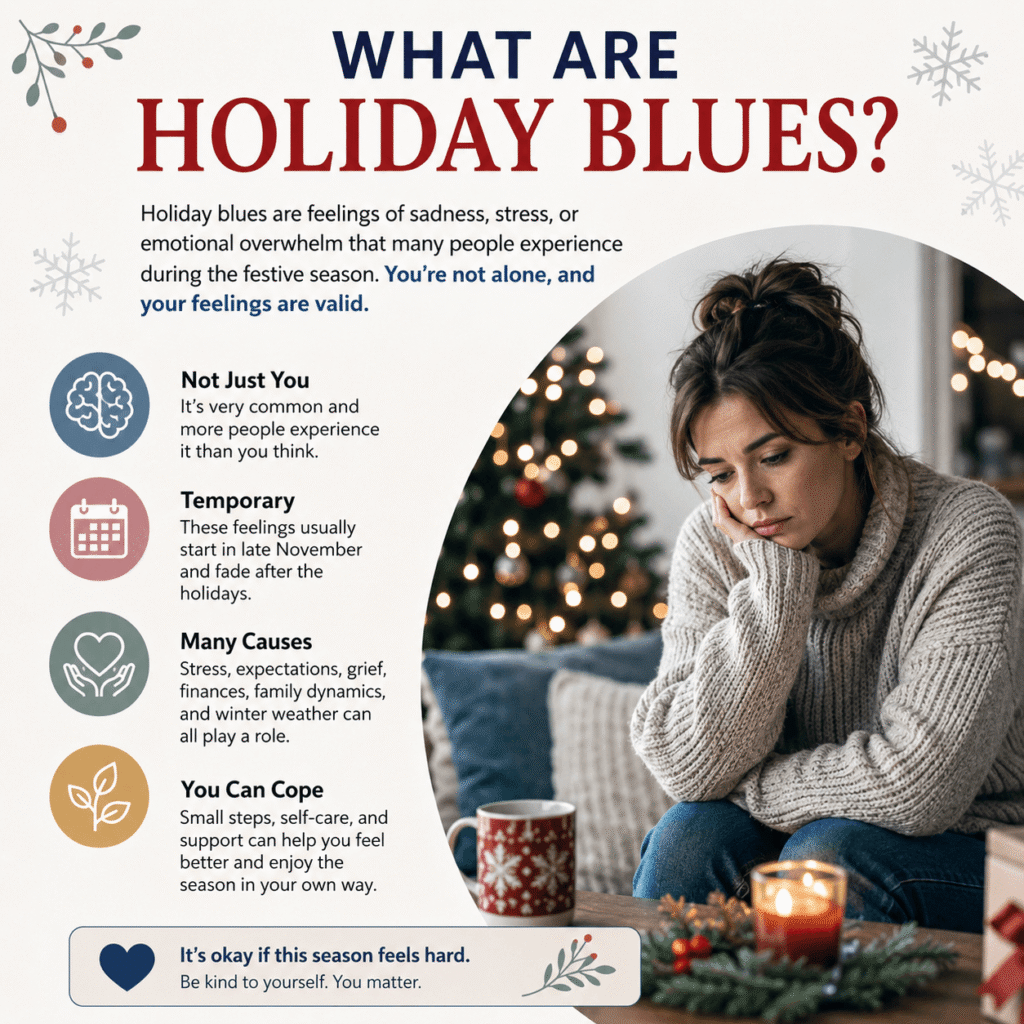
This hits everyone differently. For some, it’s just a passing wave of nostalgia on a quiet evening. For others, it’s a heavy, physical exhaustion that makes getting out of bed tough. The National Alliance on Mental Illness notes that nearly 64% of people with existing mental health struggles find things get harder now, but it hits plenty of people who usually feel completely fine, too.
The bottom line is that you aren’t failing at the holidays. Your feelings make total sense. Once you stop beating yourself up for not being a walking billboard of festive cheer, you can give yourself some grace and take a few gentle steps to get your balance back.
Holiday Blues Symptoms You Shouldn’t Ignore
Let’s be real: this stuff sneaks in pretending to be regular burnout, until suddenly you realize you’re drowning in it. If you notice a few of these things hitting you at once, don’t beat yourself up. It’s just your body trying to tell you that you’re running on empty.
First, there’s that heavy, random sadness. It’s a dull ache in your chest, tearing up at a cheesy commercial, or carrying around a cloud you can’t quite explain. Then comes the irritability. May be a passive comment which is aggressive or a personal attack. You find yourself snapping at the people you love, and then feeling terrible about it.
Your body feels the weight, too. It’s a bone-deep exhaustion that sleep can’t fix. Your nights get completely messy—either you’re staring at the ceiling at 3 AM with your mind racing over budgets, or you just want to hide under the covers all day. You might also start quietly pulling away, dodging group chats and turning down party invites because the energy required to put on a happy face feels totally impossible. But staying home often backfires, leaving you feeling even more isolated. Finally, your brain just fogs over. You might find yourself staring blankly at a roll of wrapping tape or walking into a store and completely forgetting what you came for.
These moments aren’t personal failures, and you aren’t being a Scrooge. They are just loud, clear signals from your mind and body asking you to take a breath, drop the heavy expectations, and gently check in with yourself.
Why Do Holidays Trigger Emotional Distress ?
Behind the scenes of every emotional crash lies a mix of psychology, biology, and circumstance. The holidays are essentially a perfect storm of all three. Understanding why your brain and body react this way is incredibly validating—when you grasp the actual science, you stop blaming yourself and start working with your biology instead of fighting it.
First up are the impossible expectations. We’ve been conditioned since childhood by movies and commercials to expect pure magic. When reality delivers a burnt dinner, an underwhelming gift, or a tense conversation, that gap between expectation and reality registers in your brain a lot like grief. Forced family togetherness often forces old wounds to resurface, while financial panic over gifts and travel keeps your nervous system in a constant state of fight-or-flight.
Grief also hits differently this time of year. Watching everyone else’s curated, “perfect” holiday highlights on social media only amplifies that ache. On top of that, your entire routine gets thrown out the window—sleep schedules shift, eating habits change, and your body’s natural rhythms get completely derailed.
Finally, there’s actual brain chemistry at play. Shorter days mean less sunlight, which tanks your serotonin (the happy chemical) and disrupts your circadian rhythm. Lower vitamin D and messy melatonin cycles can trigger Seasonal Affective Disorder, literally dragging your mood down from the inside out.
You aren’t imagining things, and you aren’t just being negative. Your environment, your history, and your brain chemistry are all colliding. Recognizing these triggers is the first step toward protecting yourself from the storm.
Holiday Blues vs Clinical Depression: Understanding the Difference
Figuring out whether you’re dealing with a temporary case of the holiday blues or something deeper, like clinical depression, is one of the most important check-ins you can do for yourself. On the surface, they feel incredibly similar, but they are actually pretty different when you look at how long they stick around, how heavy they feel, and how much they disrupt your life.
Think of the holiday blues as a passing storm. It usually lasts a few days or weeks and clears up once January rolls around and life goes back to normal. The emotional funk is uncomfortable, but it’s still manageable—you can still show up for work, text your friends back, and get things done. Your mood might even lift if you get caught up in a movie or a good conversation. It’s tied directly to the stress of the season, and deep down, you still feel like things will get better.
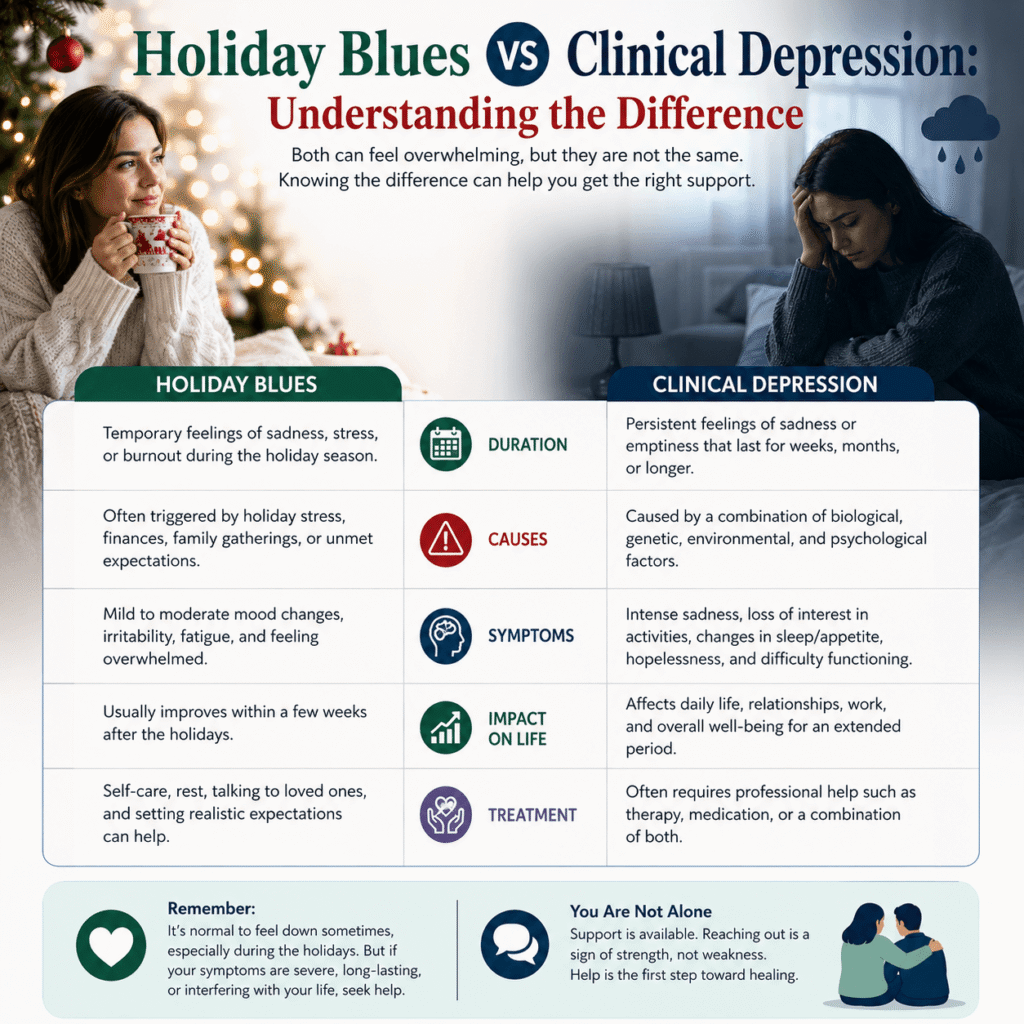
Clinical depression, though, doesn’t care about the calendar. It feels heavy and debilitating, making basic everyday things like getting out of bed, showering, or making a meal feel completely impossible. Even when something genuinely good happens, that low mood won’t budge, and it often brings a deep, exhausting sense of hopelessness.
If your symptoms are dragging on past January, making it hard to survive your day, or if you’re having any thoughts of self-harm, please listen to your gut. There is absolutely zero shame in reaching out to a therapist or doctor. Recognizing that you need a helping hand isn’t a weakness; it’s a massive sign of strength and self-awareness.
Who Is Most Vulnerable to Holiday Blues?
While anyone can get hit by the holiday blues, the truth is that the deck is stacked against certain groups. It’s not about weakness; it’s just an honest look at how life circumstances can make this time of year uniquely brutal. Knowing if you or someone you care about is in one of these lanes helps you see the storm coming and prepare for it.
Older adults often bear a heavy burden, especially those living alone who are quietly navigating the ache of outliving spouses or friends. Limited mobility means they can’t always show up, amplifying the isolation. On the flip side, caregivers are running on absolute empty. When you care for your loved one with some festive expectation will leave them physically and emotionally exhausted and even drained mentally. They may become frustrated or even resentful sometimes.
Students, too, get caught in a messy mix of homesickness, final exams, and the high cost of traveling home. For international students or fresh college kids stuck on campus, the loneliness can be overwhelming. Routine disruptions also wreak havoc on anyone managing a chronic illness, where missed sleep or messy eating can quickly trigger a frustrating downward physical and emotional spiral.
Then there is the sheer weight of expectations. For anyone already fighting anxiety or depression, the forced socializing and darker days can completely overwhelm their usual coping skills. Financial stress adds another layer of panic, where tight budgets turn into feelings of shame or inadequacy.
Whether you are navigating a recent grief, going through a divorce, facing family estrangement, or protecting your recovery, the holidays are a minefield. If you’re in the thick of it, please remember: your exhaustion makes complete sense. Your struggles are real, and you don’t have to navigate them perfectly.
The Physical Health Connection Most People Overlook
Here’s something most holiday advice completely ignores: your mood and your body are hooked up to the exact same system. When the holiday chaos messes with your physical health, your mental health takes a massive, immediate hit. It creates a brutal feedback loop, but it also gives you a secret weapon—if you fix the physical stuff, your mood will usually follow.
First up is sleep, or the total lack of it. Between late-night parties, travel, and stress, your sleep schedule gets completely trashed. Missing out on deep sleep instantly tanks your ability to handle stress—by up to 30%, in fact. When you’re exhausted, the emotional center of your brain goes into hyperdrive, making a minor inconvenience feel like an absolute catastrophe.
Then there’s the holiday diet. Surviving on a non-stop loop of cookies, heavy meals, and cocktails sends your blood sugar on a wild roller coaster. Every sweet high is followed by a massive crash that leaves you feeling shaky, irritable, and completely brain-fogged. Add alcohol to the mix—which is a depressant that ruins your sleep and dehydrates your brain—and you have a perfect recipe for a next-day anxiety spiral.
The busiest weeks of the year are also when it’s easiest to forget your daily routine. Missing doses of medication—whether it’s for mental health, thyroid, or blood pressure—because you’re traveling or forgot to get a refill can cause sudden mood swings and physical crashes before you even realize what happened.
On top of that, stress physically tightens your muscles, making chronic pain flare up just when you have the least amount of time to deal with it. When you factor in winter dehydration and a total lack of sunlight, your body is essentially screaming for a break. Taking care of your physical basics isn’t just a chore—it’s the fastest way to get your mind back on track.
Evidence-Based Ways to Manage Holiday Blues
The encouraging news is that the holiday blues respond incredibly well to small, practical changes. You don’t need an expensive lifestyle overhaul or hours of free time; you just need a few consistent habits to completely shift how you feel. The trick is being proactive—setting up your defence before the seasonal chaos completely takes over.
Your body and brain thrive on predictability. Try to wake up, eat, and go to bed at the same times you usually do. Don’t drop your workouts, either. Exercise is one of the most powerful mood boosters we have. Even a quick, 20-minute walk outside during peak daylight does double duty by pumping up your endorphins and giving you the sunlight your brain is starving for.
When it comes to sleep, make it non-negotiable. Aim for those seven to nine hours, keep your room cool, and ditch the screen scrolling before bed. On the food front, enjoy the holiday treats without the side of guilt, but try to balance them out with real meals so your blood sugar doesn’t take a nose-dive. Skipping breakfast to “save room” for a massive dinner is a surefire recipe for a mid-afternoon emotional crash.
You don’t need to buy the perfect gifts, host a flawless dinner, or say yes to every single invite. “No” is a complete sentence. Keep an eye on the alcohol, too, since that festive buzz can easily turn into a three-day mood slump. Finally, focus on real connection over forced socializing. A quiet, honest phone call with a genuine friend will do infinitely more for your mental health than enduring three awkward holiday parties. Find what works for you, protect your boundaries, and take it one day at a time.
When Should You Seek Professional Help?
While the holiday blues usually pack up and leave when the decorations come down, sometimes the weight is just too much to carry alone. Knowing when to call in backup isn’t a failure—it’s the smartest, bravest thing you can do for yourself. Your mental health matters just as much as your physical health, and you don’t have to wait until you’re completely broken to ask for help.
There are a few clear signs that it’s time to talk to a professional. If that heavy, suffocating sadness doesn’t budge as January turns into February, it’s a sign that this is deeper than a seasonal slump. If you are experiencing terrifying anxiety, panic attacks, or physical symptoms like a racing heart, that deserves real attention. The biggest red flag is when your ability to survive the day shuts down—if you can’t get out of bed, handle basic hygiene, keep up at work, or care for your kids, self-care alone isn’t going to cut it.
Other things to watch out for include completely shutting out the people who love you, a total loss of interest in anything that used to bring you joy, or a constant, toxic loop of worthlessness and hopelessness about the future.
Most importantly: if you ever have thoughts of self-harm or suicide, it is an immediate emergency. Please don’t hesitate or wait it out.
Whether it’s booking a quick telehealth appointment with a therapist or talking to your doctor, getting support early changes everything. What feels completely impossible and overwhelming right now is highly treatable, and you deserve to feel like yourself again.
Frequently Asked Questions
What causes the holiday blues?
The holiday blues are a perfect storm where psychology, biology, and stress collide. Psychologically, the massive gap between picture-perfect media expectations and a messy reality—like family arguments or tight budgets—registers in the brain a lot like grief. Biologically, shorter winter days cause a drop in mood-regulating serotonin. Combined with the exhaustion of packed schedules, your nervous system simply runs out of fuel.
How long does the holiday blue last?
The trait of the holiday blues is temporary. They start emerging around late November and will go away by mid-January or once the festive rush is ended and everything returns to normal. However, if it still goes on to the February then you might be dealing with seasonal affective disorder that is (SAD) or even the clinical depression.
Is holiday blues counted in a form of depression?
No, it is not a depression type however it is a short term and situational reaction to the seasonal stress. Your mood may often get distracted or when resting. It is the formal mental health condition which will persist for may be months or weeks.
Can stress make this condition worse ?
Yes chronic stress disturbs the cortisol and also the brains level of serotonin with dopamine. Without the control on these a minor frustration such a long grocery line can trigger the emotional crash.
Does a lack of sleep affect mood?
Yes, sleep deprivation is a massive mood-killer. Holiday travel and late-night parties disrupt our sleep, yet just a single night of poor rest can slash your stress tolerance by up to 30%. When you are exhausted, the emotional center of your brain (the amygdala) goes into hyper drive, making you incredibly vulnerable to irritability, anxiety, and deep sadness.
What is the role of chronic illness in this?
A chronic illness condition such as diabetes or any autoimmune disease adds the difficulty layer. Any holiday travel or a chaotic schedule may miss your medication dose and lose sleep. The rich festive food may also trigger the physical inflammation. When you body experiences the physical crash, it will emotionally reserve the feeling of isolation.
How can the mood be improved?
You may focus on the small and consistent habits. You may guard your sleep schedule and aim for 7-9 hours complete sleep. twenty minutes of daylight to boost your serotonin. You may give yourself a explicit permission to say no which will drain invitations. You can balance the holiday treats with your regular meals so that you prevent the blood sugar crash and check on low-pressure and genuine connection.
When does a Professional help can be needed?
Reach out to a professional if your low mood lasts more than two consecutive weeks, stretches past January, or completely shuts down your ability to function daily. Severe anxiety, panic attacks, or losing all interest in things you love are clear red flags. Most importantly, if you have thoughts of self-harm, treat it as an immediate emergency and call or text 988 right away.
Can the medications affect mood?
In holiday chaos it is to forget the daily medication doses or even you may fail to refill deadlines. Consistency in medication such as thyroid treatments and anti-depressants are needed. When you miss even a single does you may miss chemical withdrawal which may cause intense irritation and anxiety with fatigue which people may mistake for the holiday blues.
How much common are the holiday blues?
They are incredibly widespread. Data from the National Alliance on Mental Illness shows that 64% of people with existing mental health conditions report their symptoms worsen during the holidays. Additionally, roughly 38% of the general population experiences a measurable dip in mood during this time. You aren’t a Scrooge; you are just navigating a universally demanding season.
Can they affect kids and teens?
Yes. Children and teenagers are highly sensitive to family tension, the disruption of their school routines, or academic final exams. Because they may lack the words to express holiday burnout, their blues usually show up behaviorally through sudden withdrawal, unusual irritability, or changes in sleep. They need a safe space to vent and plenty of quiet downtime.
What is the difference between holiday blues and SAD?
The holiday blues are situational, tied to seasonal stressors, and resolve quickly in January. Seasonal Affective Disorder (SAD) is a formal type of clinical depression triggered biologically by the lack of winter sunlight. SAD disrupts your biological clock and drops serotonin production consistently through the entire winter, requiring medical treatments like specialized light therapy.
Can social media make things worse?
Definitely. Scrolling through curated holiday highlight reels triggers intense social comparison. Your brain automatically compares your exhausting, real-life reality to someone else’s polished, filtered best moments. This creates an immediate sting of inadequacy and loneliness. Protecting your peace during December often means doing a digital detox or heavily limiting screen time.
Are there foods that help my mood?
What you eat directly impacts your brain chemistry. While sugar and cocktails trigger rapid blood sugar spikes followed by severe mood crashes, other nutrients help. Foods rich in omega-3s (salmon, walnuts) reduce brain inflammation, complex carbs (oats, quinoa) provide steady energy, and lean proteins provide the amino acids your body needs to build feel-good serotonin.
Can exercise really make a difference?
Yes, regular movement is a fast, scientifically proven way to lift a slump. Exercise instantly releases endorphins while burning off the excess cortisol caused by holiday anxiety. You don’t need a grueling gym session; just 20 to 30 minutes of moderate activity like a brisk walk or yoga can produce a measurable improvement in your mood within two weeks.
Is alcohol a good way to cope?
No. Alcohol is a central nervous system depressant that actively depletes your natural serotonin levels once it leaves your system, leaving you more anxious and sadder the next day. It also severely ruins your sleep quality and causes dehydration. If you are stressed, you will find far more relief in a warm bath or a walk.
What are “post-holiday blues”?
This is a wave of emptiness and fatigue that hits in early January. For weeks, your brain was fueled by bright lights, anticipation, and high stimulation. When the festivities abruptly stop and you are faced with cold winter weather and credit card bills, your brain chemistry goes through a literal withdrawal. Easing back into your routine gradually can smooth this transition.
Should I take Vitamin D in the winter?
It is highly worth discussing with your doctor. Shorter days and indoor winter living cause severe Vitamin D deficiencies for millions of people. Because low Vitamin D is directly linked to chronic fatigue, anxiety, and depression, a simple blood test can help your doctor recommend a safe daily supplement dosage to protect your brain chemistry from the winter dip.
Conclusion
Let’s be honest: the holidays are a lot. They are a messy, beautiful, exhausting, and sometimes genuinely painful mix of emotions all crammed into a few intense weeks. If you’ve found yourself stuck in a funk this year, please know that your feelings make complete sense. You aren’t broken, you aren’t being a Scrooge, and you are far from the only person quietly struggling to get through it.
Because your mind and body are hooked up to the exact same system, getting back to the physical basics is the quickest way to find your footing. Small, daily choices—like guarding your sleep, sticking to a loose routine, eating actual meals, watching the drinking, and keeping up with your medications—give your brain the chemical backup it needs to handle the stress. Give yourself permission to lower the bar. The “perfect holiday” doesn’t exist anywhere except in movies and filtered Instagram posts; trying to chase it will only leave you completely burnt out.
If the dark cloud won’t lift, gets heavier, or if you start having thoughts of self-harm, please don’t try to tough it out alone. Reaching out to a professional isn’t a weakness—it is a massive sign of strength and self-awareness. Real, life-changing support is out there, and you deserve to feel like yourself again.
At GenPharmaRx, we’re here to back you up through the ups and downs of your entire health journey—mind, body, and spirit. Be incredibly gentle with yourself over the next few weeks, drop the expectations that don’t serve you, and remember that protecting your own peace is the best thing you can do for yourself and the people who love you.
More Blogs